Four and a half years have passed since that terrible day when the FBI called. I still wonder, almost every day, why I didn't figure it out sooner. What signs did I miss? Why was I so ignorant about the gathering dangers, poised to take down an elderly woman with a fair amount of money and impaired judgment? Could I have stopped her victimization before she lost so much?
Sure, I was worried about her. She was easily confused. The refrigerator always contained spoiled food and had sweepstakes notifications stuck to the outside. Huge stacks of unread magazines lined the family room and hallway, sometimes 3 or 4 copies of the same magazine, all ordered through channels with sweepstakes.
She had fired her financial adviser in early October of 2002 (likely under the urging of her Canadian lottery callers), liquidated all of her assets, and announced that she would handle her own investments henceforth. She explained that her mutual fund losses were responsible for the huge decline in the size of her portfolio. Horrified and suspicious, I talked her into finding another financial advisor. She did so, and I relaxed a little (a little too much apparently).
On the other hand, she lived alone, had some close friends, paid her bills (as far as I knew), shopped, cooked, and even served as treasurer for her ladies' club. Between us, my sister and I visited and spoke with Lola often. She was starting to have some memory problems, enough to make us uneasy, but not enough to trigger decisive action on our part.
Diagnosis: Early (mild) Alzheimer's and Vascular Dementia
Along with the emergency court order granting me guardianship in January 2004, the judge also ordered medical evaluation of Lola's mental condition since Lola refused to do this voluntarily.
Exams by a neuropsychologist and a psychiatrist found that Lola had both early Alzheimer's and vascular dementia. Even so, she did well enough on the mini mental exam to meet state criteria for "being of sound mind" for the purpose of making out a will. Everyone who knew her (immediate family excepted) was shocked at the diagnosis. Lola was masterly at hiding her deficits and activities from those around her (except for banking employees and con artists).
It was now clear to me that judgment and the ability to reason were the first skills to go, in Lola's sad decline. The stereotype of the dotty old lady who can't recall what she had for breakfast as emblematic of dementia does not hold up for many seniors. I now knew that a person could appear outwardly to be competent, yet have not a shred of rationality left.
Sunday, July 27, 2008


Monday, July 21, 2008
Mighty big checks
Here's a partial list of some of the large checks that Lola wrote for various scams. I found them in check registers and verified them against statements from two banks and other records. This list is by no means exhaustive. Most checks ultimately went to Canada, some in the form of wire transfers; an exception is $15000 to the alleged Banco de Costa Rica. Note that some of the payee's names resemble those of well-known companies, possibly to gain the trust of the scam victim.
Do you see why I eventually stopped counting her losses?
| Date | Payee | Amount | |
| 4/3/2002 | Sierra Promotions | $750.00 | |
| 10/11/2002 | Cashier's check | $1,987.95 | |
| 10/11/2002 | Cashier's check | $12,950.00 | |
| 12/5/2002 | Sierra Promotions | $600.00 | |
| 12/9/2002 | payee unknown | $2,000.00 | |
| 1/3/2003 | ADM | $600.00 | |
| 1/31/2003 | PMG | $475.00 | |
| 2/10/2003 | Sierra Promotions | $750.00 | |
| 3/26/2003 | PMG | $475.00 | |
| 5/4/2003 | Banco Costa Rica | $15,000.00 | |
| 5/5/2003 | N. International | $990.00 | |
| 5/7/2003 | Newport Group | $1,998.00 | |
| 5/8/2003 | Safe Investments Inc. | $19,900.00 | |
| 5/29/2003 | PMG | $1,425.00 | |
| 6/19/2003 | ADM | $599.00 | |
| 7/3/2003 | GCS | $20,000.00 | |
| 7/14/2003 | ADM | $790.00 | |
| 7/16/2003 | S.G. Inc | $399.00 | |
| 7/16/2003 | PMG | $700.00 | |
| 7/25/2003 | ADM | $698.00 | |
| 7/29/2003 | BCS - H. Diamond | $997.00 | |
| 7/30/2003 | ADM | $599.00 | |
| 8/22/2003 | Cash | $3,000.00 | |
| 8/26/2003 | Marathon Co. | $598.21 | |
| 9/2/2003 | Cash | $2,000.00 | |
| 9/19/2003 | Cash | $1,000.00 | |
| 10/9/2003 | Cash | $750.00 | |
| GCS | $10,000.00 | ||
| PMG | $2,400.00 | ||
| ADM | $599.00 | ||
| Marathon Co. | $598.00 |
Do you see why I eventually stopped counting her losses?
Thursday, July 17, 2008
How MBNA Abused Lola
After the guardianship hearing in January 2004, I confiscated Lola's credit cards. I questioned Lola about how much she owed, and she thought it was about $2000. I breathed a sigh of relief, thinking it could have been a lot worse. When I located the latest bills, which were on the kitchen counter, open but unpaid, I learned that it actually was a lot worse.
The American Express card wasn't too bad; she owed less than $1,000 on it. The MBNA bill was another story. She had two MBNA cards; one had a balance due of about $12,000 while the other account had a few hundred on it.
All her life, Lola had always paid off her credit cards each month. This level of credit card debt was unprecedented and deeply disturbing.
It seems that when Lola ran out of money to wire to Costa Rica and Canada, she wrote a check for $10,000 against her MBNA Visa card and deposited it in her bank. You know those credit card checks that come in the mail from time to time? Yep, one of those. MBNA very kindly and generously doubled her credit limit so she could do this.
I diligently paid about $50 more than the minimum payment each month, increasing the payment a little as soon as I sold the car.
Since I made reasonable and timely monthly payments, I was astounded when I opened an MBNA bill in midsummer 2004 and saw that the interest rate had jumped from around 15% to a ruinous and usurious 27%.
Outraged, I picked up the phone and started calling. For an hour or so I talked to everyone but the CEO, repeated my story over and over, and spent more time on hold than talking. Finally, the customer service representative revealed his findings: "We raised her rate because those regular payments indicated that she was treating the charges like a long term loan." Yes, he really did say that, in almost those exact words.
MBNA knew the situation of course. I had sent them the guardianship court order a week after I got it; the image was available on line to everyone I ever spoke with. I had even tried to disallow any future charges to the card. They said they couldn't do that; I would have to review each bill and dispute any charges that appeared, and there were many. I had spent hours on the phone with MBNA in early 2004, even filing a fraud complaint for $1000 worth of suspicious charges from psychics, publishers, and someone in Amsterdam.
My next step was to lobby the CSR for an interest rate reduction. This was even harder than getting an explanation. Another couple of hours and a manager or two later, I finagled a reduction to 18%, effective the next monthly bill.
Alas, it was almost a year after this MBNA debacle, that I closed on the house. During that time, I had to pay that outrageous 18% interest rate. I paid off this account the day I deposited the proceeds. I seldom use credit cards anymore.
You probably know that Bank of America bought MBNA. They deserve each other.
The American Express card wasn't too bad; she owed less than $1,000 on it. The MBNA bill was another story. She had two MBNA cards; one had a balance due of about $12,000 while the other account had a few hundred on it.
All her life, Lola had always paid off her credit cards each month. This level of credit card debt was unprecedented and deeply disturbing.
It seems that when Lola ran out of money to wire to Costa Rica and Canada, she wrote a check for $10,000 against her MBNA Visa card and deposited it in her bank. You know those credit card checks that come in the mail from time to time? Yep, one of those. MBNA very kindly and generously doubled her credit limit so she could do this.
I diligently paid about $50 more than the minimum payment each month, increasing the payment a little as soon as I sold the car.
Since I made reasonable and timely monthly payments, I was astounded when I opened an MBNA bill in midsummer 2004 and saw that the interest rate had jumped from around 15% to a ruinous and usurious 27%.
Outraged, I picked up the phone and started calling. For an hour or so I talked to everyone but the CEO, repeated my story over and over, and spent more time on hold than talking. Finally, the customer service representative revealed his findings: "We raised her rate because those regular payments indicated that she was treating the charges like a long term loan." Yes, he really did say that, in almost those exact words.
MBNA knew the situation of course. I had sent them the guardianship court order a week after I got it; the image was available on line to everyone I ever spoke with. I had even tried to disallow any future charges to the card. They said they couldn't do that; I would have to review each bill and dispute any charges that appeared, and there were many. I had spent hours on the phone with MBNA in early 2004, even filing a fraud complaint for $1000 worth of suspicious charges from psychics, publishers, and someone in Amsterdam.
My next step was to lobby the CSR for an interest rate reduction. This was even harder than getting an explanation. Another couple of hours and a manager or two later, I finagled a reduction to 18%, effective the next monthly bill.
Alas, it was almost a year after this MBNA debacle, that I closed on the house. During that time, I had to pay that outrageous 18% interest rate. I paid off this account the day I deposited the proceeds. I seldom use credit cards anymore.
You probably know that Bank of America bought MBNA. They deserve each other.
Friday, July 11, 2008
In Her Own Words
In early 2004, in an effort to keep my mother busy while I held her captive in my home, I had her write narratives from a disorganized mess of notes jotted down in haste during phone calls from scam artists. My intention was to pass this information on to the FBI in a more useful form than the notes on the little snippets of yellow paper everywhere. What follows is excerpted from a narrative inexplicably started in 2003 at the request of Claude, one of the scam artists. Lola said he was high up in the Canadian government and needed this information . She continued work on it at my house, and I gave a copy to the FBI.
Canadian Sweepstakes Group
This is an account of the beginning of a call from a Quebec Canada gentleman (Steve Mercer) of Dorval, Quebec, who I believe was a customs agent. He advised me that I had won a sweepstakes from some organization and his office, I believe it was Canadian Customs and they would be handling the paperwork and delivery when all the fees were taken care of and he would be back in touch, however, he did say winnings was a check for $125,000. A few days or weeks he called back and advised the winnings were two checks of $125,000 each and the fees had to be sent via Western Union to various people at several different locations. Below is the list of amounts, names, fee charges, etc. and dates. [All transmissions were to Dorval, Quebec, Canada and incurred $139 each in Western Union fees]
8/20/2003 $2,560 to Katherine Winslow,
8/21/2003 $2,990 to Steve Mercer,
8/22/2003 $2885 to Howard Sands,
8/28/2003 $2640 to James Gray
9/12/2003 $2430 to Gary White
9/15/2003 $2400 to Alfred Kennedy
10/9/2003 $2740 to George Grant
10/9/2003 $2760 to Arthur Wellington
Some of the customs agents out of Canada were quite difficult and rude to talk to. Here is a list if it would help you any. Robert Garcia was supposed to be Canadian. [I have several lists, but I'm not sure which one goes with this particular narrative.]
This doesn't sound like vast sums of money, but it's a drop in the bucket of Lola's total losses. I stopped counting at around $260,000 lost to fraud in the 18 months prior to the guardianship. It hurt too much to keep looking at those bank statements and checks. My lawyer said her case was the worst that he had heard of.
It is not a coincidence that one of the recipients of her wire transfers was "named" James Gray. That was my father's name. The name Gray turns up frequently in the lists of people who called her.
Canadian Sweepstakes Group
This is an account of the beginning of a call from a Quebec Canada gentleman (Steve Mercer) of Dorval, Quebec, who I believe was a customs agent. He advised me that I had won a sweepstakes from some organization and his office, I believe it was Canadian Customs and they would be handling the paperwork and delivery when all the fees were taken care of and he would be back in touch, however, he did say winnings was a check for $125,000. A few days or weeks he called back and advised the winnings were two checks of $125,000 each and the fees had to be sent via Western Union to various people at several different locations. Below is the list of amounts, names, fee charges, etc. and dates. [All transmissions were to Dorval, Quebec, Canada and incurred $139 each in Western Union fees]
8/20/2003 $2,560 to Katherine Winslow,
8/21/2003 $2,990 to Steve Mercer,
8/22/2003 $2885 to Howard Sands,
8/28/2003 $2640 to James Gray
9/12/2003 $2430 to Gary White
9/15/2003 $2400 to Alfred Kennedy
10/9/2003 $2740 to George Grant
10/9/2003 $2760 to Arthur Wellington
Some of the customs agents out of Canada were quite difficult and rude to talk to. Here is a list if it would help you any. Robert Garcia was supposed to be Canadian. [I have several lists, but I'm not sure which one goes with this particular narrative.]
This doesn't sound like vast sums of money, but it's a drop in the bucket of Lola's total losses. I stopped counting at around $260,000 lost to fraud in the 18 months prior to the guardianship. It hurt too much to keep looking at those bank statements and checks. My lawyer said her case was the worst that he had heard of.
It is not a coincidence that one of the recipients of her wire transfers was "named" James Gray. That was my father's name. The name Gray turns up frequently in the lists of people who called her.
Friday, July 04, 2008
New York Times blog
A few days ago, an excellent blog known as The New Old Age by Jane Gross debuted in the New York Times.
I've been following the blog and reading the fascinating comments since its debut.
The intended audience seems to be caregivers and future caregivers of aging parents and grandparents.
So far, there have been no posts regarding elder scams, a subject near and dear to my heart, but the blog is only three days old.
Check it out. It's well worth your time.
I've been following the blog and reading the fascinating comments since its debut.
The intended audience seems to be caregivers and future caregivers of aging parents and grandparents.
So far, there have been no posts regarding elder scams, a subject near and dear to my heart, but the blog is only three days old.
Check it out. It's well worth your time.
Tuesday, June 10, 2008
Four generations
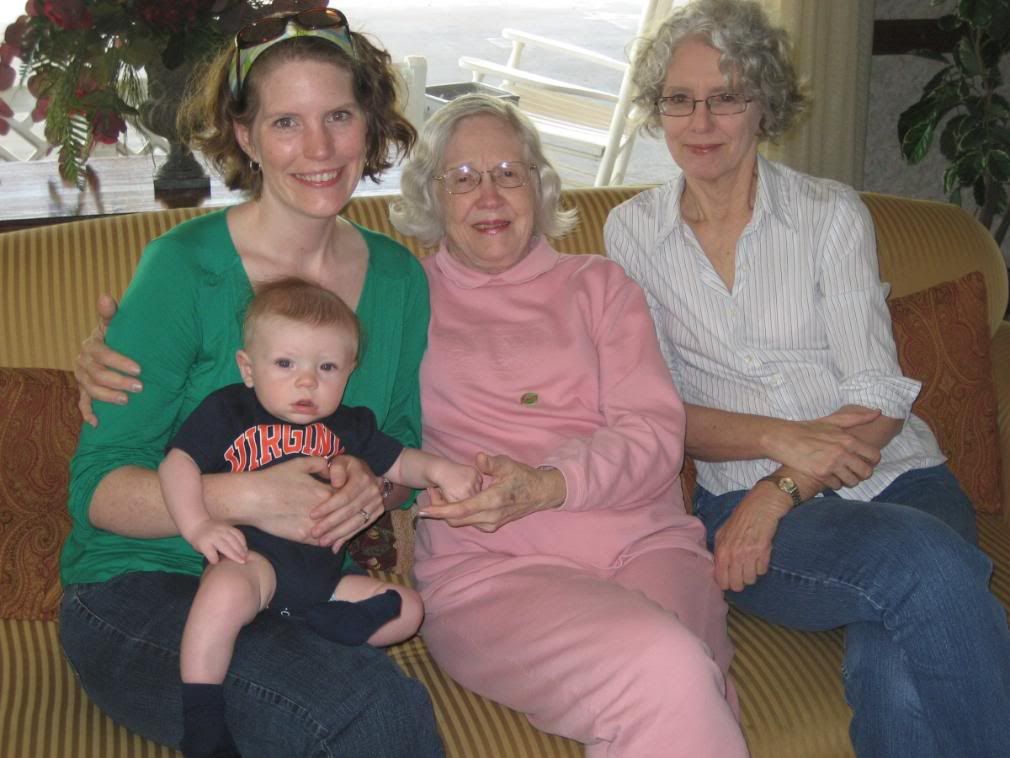
I'd like to pause the narrative to post a current picture of Lola and some of her descendents.
She lives in a nursing home now and has no memory of those terrible days of scams and guardianship and upheaval.
She still knows her family, but can't recall anything that happened in the last 25 or so years.
Monday, May 26, 2008
More on Bank of America
In one of my earlier posts, Making the Rounds of the Banks, I hinted at more to come on Bank of America.
Let me summarize events leading up to a colossal blunder on the part of BOA (Bank of America):
Are you still with me? What happened next could seriously undermine your trust in banks.
On February 5, 2004, I had the shock of my life when I opened Lola's Bank of America monthly statement. I read the statement in the post office parking lot. My hands shook and I nearly passed out. I wrung my hands, went back to work, closed the door to my office, and tried to make sense of the bizarre chain of events that followed my January 28 call to BOA.
It gets worse.
I never heard from Bank of America again. Not everyone is so lucky.
Let me summarize events leading up to a colossal blunder on the part of BOA (Bank of America):
- On January 16, 2004, I froze Lola's overdrawn checking account at BOA and closed her plundered money market account, drained of all funds by the con artist known as John Mason.
- On January 28, 2004, I called Bank of America's fraud department and filed a fraud claim on the defunct money market account in the amount of $20,321.35 because that was the amount that "Mason" had withdrawn in the previous sixty days.
- In the course of the same call, I tried to file a fraud claim on the frozen checking account too, but they wouldn't let me. There was no way to prove that anyone other than Lola had authorized the telephone transfers of large sums from the checking account into the money market account for John Mason to withdraw.
Are you still with me? What happened next could seriously undermine your trust in banks.
On February 5, 2004, I had the shock of my life when I opened Lola's Bank of America monthly statement. I read the statement in the post office parking lot. My hands shook and I nearly passed out. I wrung my hands, went back to work, closed the door to my office, and tried to make sense of the bizarre chain of events that followed my January 28 call to BOA.
- The FROZEN checking account, originally with a negative balance of about $200, now had a positive balance in the neighborhood of $10,000.
- On January 29 (the day after my conversation with the fraud department), the bank had credited the $20,321.35 fraudulently withdrawn from the money market account TO THE FROZEN checking account.
- Two large checks written by Lola on January 9 to two Canadian entities ( in reality, probably a single scam) had cleared the FROZEN account (which now contained lots of money). The first check cleared on January 29, the second on February 2. Each check was written for just under $5000, for a total of $9900. At that time, checks in an amount over $5000 would have attracted bank and regulatory scrutiny. Well, at most banks that is. BOA reactivates frozen accounts with a history of fraudulent transactions and puts money in them.
It gets worse.
- Predictably, Bank of America denied my fraud claim on February 27. After all, Lola had mailed her ATM card to John Mason and included the PIN. Upon denial of the claim, the $20,321.35 in dispute was removed from the checking account. Now the account had a negative balance of about $10,000.
- When I notified Beverly, the Bank VP in Little Rock, she said I (on behalf of Lola) owed the bank the $10,000. My lawyer told me they didn't have a leg to stand on. It didn't matter. I was sick with fear.
- I wrote detailed letters attaching copies of checks and statements along with pertinent facts and sent them to three different Bank of America locations -- the fraud department, customer service, and the billing department. I fretted and fumed for weeks. No one ever called me or contacted me. Finally, on April 23, 2004, a kind person in a BOA office somewhere in Florida told me that the case had been assigned to an investigator. He probably violated some privacy law in telling me that.
I never heard from Bank of America again. Not everyone is so lucky.
Monday, December 31, 2007
Rainy December Nights
Every single time I went out, it was the same. A cold rain was falling. Lane markings were obscured by a reflective layer of water disturbed by rain drops and splashes. The water shifted uneasily in colorful waves thrown at it by building lights, neon signs, passing cars, and traffic lights. The rhythmic sweep of the windshield wipers muffled the sound of the spray.
I parked the car and headed for the hospital doors barely protected by my flimsy hooded raincoat, stepping gingerly around the pooling water. Two unused umbrellas rested in the car.
When I wasn’t in Mother’s room, I was sitting in the massive third floor lobby. It curved outwards from the patient areas and faced the four stories tall windowed atrium. At night, the panoramic view of the commercial area north and east of the hospital repeated itself wavily in the rain drenched parking lots and nearby roads.
Mother saw rivers of green dots on the metal surfaces of the ER and swarms of red and brown spots on the walls of her room. Who’s to say what I saw was real and what she saw wasn’t?
Mother moved to the psychiatric unit of the old hospital and the landscape was much the same. The surfaces were smaller and the puddles were bigger with more subdued residential lights reflecting off the unmarked parking lot.
Today, in the locked down “C” hall (dementia unit) of the nursing home, two confused patients followed me and Mother down the hall to her room. Distracted after a while, they continued their pacing while Mother and I sat on the bed. She is telling me that she has another room on the same side of the hall and three more on the other side.
Tonight is the last night of December, 2007. At least it stopped raining.
I parked the car and headed for the hospital doors barely protected by my flimsy hooded raincoat, stepping gingerly around the pooling water. Two unused umbrellas rested in the car.
When I wasn’t in Mother’s room, I was sitting in the massive third floor lobby. It curved outwards from the patient areas and faced the four stories tall windowed atrium. At night, the panoramic view of the commercial area north and east of the hospital repeated itself wavily in the rain drenched parking lots and nearby roads.
Mother saw rivers of green dots on the metal surfaces of the ER and swarms of red and brown spots on the walls of her room. Who’s to say what I saw was real and what she saw wasn’t?
Mother moved to the psychiatric unit of the old hospital and the landscape was much the same. The surfaces were smaller and the puddles were bigger with more subdued residential lights reflecting off the unmarked parking lot.
Today, in the locked down “C” hall (dementia unit) of the nursing home, two confused patients followed me and Mother down the hall to her room. Distracted after a while, they continued their pacing while Mother and I sat on the bed. She is telling me that she has another room on the same side of the hall and three more on the other side.
Tonight is the last night of December, 2007. At least it stopped raining.
Sunday, November 18, 2007
Hog Killing Day
Mother was in the mood to reminisce when I visited her at her assisted living facility two days ago.
Mother makes the Lane farm in Independence County sound like a paradise for children. They (the children) worked hard to help sustain the farm, but they always had plenty of good, fresh food to eat – tomatoes, watermelons, squash, beans, greens, apples, pears, peaches, strawberries, blackberries. She left there when she was six years old because times were so hard for Arkansas farmers in 1930 that her parents moved to Oklahoma where it turned out to be even worse. She doesn’t seem to remember the bad times, only the fun she had up until age six and every summer after that.
She can’t remember what happened five minutes ago, but she remembers hog killing day on the family farm. Strong men were a necessity, so each family in the area had its own hog killing day in which all the neighbors participated. When it was the Lanes' turn, families came to the Lane farm to spend the day dispatching pigs, cattle, and the occasional sheep or goat. The men built scaffoldings to hang the animals from or used tree branches in shaded areas. They scalded the pigs to make skin removal easier. The meat was always salted to preserve it and smoked as well, often for days at a time. The adults did all the work while the children played. She didn't seem to be bothered at all by the carnage.
Today, her mood was darker and focused on the last few years during which she lost so much. What happened to her two drawer file cabinet? What did I do with the contents? She needs the important papers so she can make some decisions about selling her property, etc. etc. As always, when the tirades start, I try to distract her, and if that fails, I tell her I’m leaving and she either settles down or continues in the same vein. Today she continued in the same vein, so I left. I did tell her I would bring her some pictures to look at and record the names of the people in the pictures. I hope I can find that box.
Mother makes the Lane farm in Independence County sound like a paradise for children. They (the children) worked hard to help sustain the farm, but they always had plenty of good, fresh food to eat – tomatoes, watermelons, squash, beans, greens, apples, pears, peaches, strawberries, blackberries. She left there when she was six years old because times were so hard for Arkansas farmers in 1930 that her parents moved to Oklahoma where it turned out to be even worse. She doesn’t seem to remember the bad times, only the fun she had up until age six and every summer after that.
She can’t remember what happened five minutes ago, but she remembers hog killing day on the family farm. Strong men were a necessity, so each family in the area had its own hog killing day in which all the neighbors participated. When it was the Lanes' turn, families came to the Lane farm to spend the day dispatching pigs, cattle, and the occasional sheep or goat. The men built scaffoldings to hang the animals from or used tree branches in shaded areas. They scalded the pigs to make skin removal easier. The meat was always salted to preserve it and smoked as well, often for days at a time. The adults did all the work while the children played. She didn't seem to be bothered at all by the carnage.
Today, her mood was darker and focused on the last few years during which she lost so much. What happened to her two drawer file cabinet? What did I do with the contents? She needs the important papers so she can make some decisions about selling her property, etc. etc. As always, when the tirades start, I try to distract her, and if that fails, I tell her I’m leaving and she either settles down or continues in the same vein. Today she continued in the same vein, so I left. I did tell her I would bring her some pictures to look at and record the names of the people in the pictures. I hope I can find that box.
Thursday, August 09, 2007
The mail takes over
It covered every surface in the house, filled voids under, on, and behind furniture, threatened to collapse the floors. Boxes of it sat in the family room waiting to be sifted through. So much mail was arriving daily that Mother had her friend Bill install a slot in the side garage door and place a large cardboard box behind it. Each day the mailman eschewed the tiny mailbox and shoved reams and reams of paper through the slot: catalogs full of junk, sweepstakes entries and prize notifications; letters from psychics in Gibralter, France, Spain, and Canada; propaganda from Tom Delay, solicitations from senior citizen "lobbying" groups and bogus charities; brochures for anti-aging products, magazines galore, and so on. Packages, of course, continued to be left on the front porch. Legitimate mail, such as bills, got lost in the flood.
Tuesday, August 07, 2007
Publishers’ Clearing House and United States Purchasing Exchange
For years, my mother received a steadily escalating stream of packages. In the early nineties, when she was still living in Hot Springs, I started seeing a lot of boxes from United States Purchasing Exchange. Mother’s only explanation was that it was a noble entity with the lofty purpose of opening up trade with China. Years later, stumbling upon an invoice, I noticed that USPE had a sweepstakes. Of course!
That Publisher's Clearing House has long targeted the elderly is widely known. Mother ordered much more than magazines from PCH; she ordered all manner of junky stuff, with several boxes often arriving in a single day. She quickly stashed them under a bed, in a closet or in the garage before we could notice them (or so she thought). The Prize Patrol's arrival was always two weeks or thirty days or sixty days away.
Even as early as 1991, Mother's credit card bills revealed that she was spending around $400 per month on orders from USPE, Michigan bulb, and PCH. Multiple orders to Michigan Bulb in a single day were not unusual. Later on, the list grew to include sweepstakes run by such venerable brands as Reader's Digest and American Express.
Can you guess what our Christmas presents were like? Cheap jewelry, flimsy kitchen paraphernalia....
Once I gained control of my mother’s mail in 2004, my sister and I returned 16 packages to PCH in the first two weeks alone. When I cleared out the house to sell it in 2005, every nook and every cranny of every room, closet, piece of furniture, and the garage that didn’t contain boxes of junk mail were filled with thousands of dollars worth of these trinkets, many of them still in unopened packages.
United States Purchasing Exchange and Michigan Bulb went out of business, but Publisher's Clearing House is still going strong.
That Publisher's Clearing House has long targeted the elderly is widely known. Mother ordered much more than magazines from PCH; she ordered all manner of junky stuff, with several boxes often arriving in a single day. She quickly stashed them under a bed, in a closet or in the garage before we could notice them (or so she thought). The Prize Patrol's arrival was always two weeks or thirty days or sixty days away.
Even as early as 1991, Mother's credit card bills revealed that she was spending around $400 per month on orders from USPE, Michigan bulb, and PCH. Multiple orders to Michigan Bulb in a single day were not unusual. Later on, the list grew to include sweepstakes run by such venerable brands as Reader's Digest and American Express.
Can you guess what our Christmas presents were like? Cheap jewelry, flimsy kitchen paraphernalia....
Once I gained control of my mother’s mail in 2004, my sister and I returned 16 packages to PCH in the first two weeks alone. When I cleared out the house to sell it in 2005, every nook and every cranny of every room, closet, piece of furniture, and the garage that didn’t contain boxes of junk mail were filled with thousands of dollars worth of these trinkets, many of them still in unopened packages.
United States Purchasing Exchange and Michigan Bulb went out of business, but Publisher's Clearing House is still going strong.
Sunday, August 05, 2007
Selling the car

What was going on three years ago, in August 2004? Under Arkansas guardianship laws, I can’t sell so much as a toothpick from my mother’s assets without a court order. Thus, in dire need of money to support my mother, I filed a petition with the court to sell a few things – my mother’s car, her lots in Hot Springs, and her coin collection. The petition was granted around the end of the month. What I really wanted to do was sell her house, but my lawyer feared the judge would deny such a request at this stage.
As guardian, I had the authority to stop Mother from driving and did so without delay. Her car lived at my sister’s house in Benton once we confiscated it. Mother has forgotten many things in the past three years, but not the loss of her car. Three years later, she is still furious and tries to access her assets so she can buy another one.
Incredibly, she managed to renew her driver’s license last year. I don’t know how she did it, but she convinced Bill’s son to to take her to the DMV to renew it. What she hasn’t figured out yet, is that the license has been removed from her purse. We won’t tell her who did it, right?
Sadly, there is no way to stop a person with dementia from renewing a driver’s license in Arkansas, no safeguards at all. All she had to do was pass a vision test – I doubt that she could have passed the written test, but it is not required for renewal. If she could get her hands on a car, she would probably kill someone. Check out the way the California DMV deals with drivers with dementia. More states should pay attention.
The car was easy to sell. I sold it to a friend who loves it and still drives it – a 1998 silver gray Volvo.
Saturday, August 04, 2007
Three and a half years after the FBI called
Those awful events of 2004 are far behind me now. But for a long time, falling asleep each night, I was haunted by ghostly visions of my diminutive mother pacing in dark corners of my bedroom. She was always wearing her bathrobe and talking on the phone with her head bent over as if trying to keep me from hearing. With time, the nocturnal images have faded, and I dwell on those days less and less.
In the first 18 months or so of the crisis, there were places I couldn’t let my mind go. There were frauds too painful to investigate, bank statements I couldn't bring myself to view, checks that broke my heart. The distance created by the passing of time and the perspective that retirement has bestowed have blunted the pain and revulsion, allowing me to reflect upon those days and write about them with less angst.
Mother is crazier now, but safely ensconced in a retirement home since December 2004. Scam artists haven't bothered with her in a couple of years (she has no money to give them), and she seldom thinks of the lotteries and "investments" and banks unless somebody reminds her. When that happens, she justs tells everybody that Bank of America stole all her money.
Elder scams don’t seem to be in the news so much lately, but I don't doubt their continued proliferation. Watching a Dateline expose a couple of weeks ago gave me chills – the lonely, vulnerable victims, the international base of operation, the elusive perpetrators. They're still out there.
Yesterday, I found a 14 minute phone call to a porn 800-number -- foxy ladies -- in Mother's cell phone records. I suspect that she stumbled on the number by accident, fooling around with her new cell phone. Interesting, however, that she listened for 14 minutes. I had AT&T disable internet access and text messaging and cancel the MediaClub subscription that had mysteriously appeared on her bill.
In the first 18 months or so of the crisis, there were places I couldn’t let my mind go. There were frauds too painful to investigate, bank statements I couldn't bring myself to view, checks that broke my heart. The distance created by the passing of time and the perspective that retirement has bestowed have blunted the pain and revulsion, allowing me to reflect upon those days and write about them with less angst.
Mother is crazier now, but safely ensconced in a retirement home since December 2004. Scam artists haven't bothered with her in a couple of years (she has no money to give them), and she seldom thinks of the lotteries and "investments" and banks unless somebody reminds her. When that happens, she justs tells everybody that Bank of America stole all her money.
Elder scams don’t seem to be in the news so much lately, but I don't doubt their continued proliferation. Watching a Dateline expose a couple of weeks ago gave me chills – the lonely, vulnerable victims, the international base of operation, the elusive perpetrators. They're still out there.
Yesterday, I found a 14 minute phone call to a porn 800-number -- foxy ladies -- in Mother's cell phone records. I suspect that she stumbled on the number by accident, fooling around with her new cell phone. Interesting, however, that she listened for 14 minutes. I had AT&T disable internet access and text messaging and cancel the MediaClub subscription that had mysteriously appeared on her bill.
Tuesday, May 23, 2006
565 arrested in fraud schemes
I saw that headline on CNN and MSNBC today: 565 people were arrested in fraud schemes in five countries, the U.S., Canada, Costa Rica, the Netherlands, and Spain. The MSNBC article is here. And here is a Department of Justice fact sheet summarizing the crimes. Some of the crimes listed are eerily familiar.
Although this investigation is more recent than the one that included my mother's misfortunes, my thoughts went to all those names on all those little scraps of paper. They weren't real names, of course, but they were real to her. Did they arrest John Mason, Steve Mercer, Claude Azzario, Lewis Marley, Victor Torres? What about John Henry, Harry Diamond? What about all those customs agents and Lloyd's of London representatives demanding fees to deliver her lottery winnings?
I had to disconnect Mother's land line and change her cell phone number twice to get rid of Steve Mercer. Otherwise, he would still be calling, as would they all.
Although this investigation is more recent than the one that included my mother's misfortunes, my thoughts went to all those names on all those little scraps of paper. They weren't real names, of course, but they were real to her. Did they arrest John Mason, Steve Mercer, Claude Azzario, Lewis Marley, Victor Torres? What about John Henry, Harry Diamond? What about all those customs agents and Lloyd's of London representatives demanding fees to deliver her lottery winnings?
I had to disconnect Mother's land line and change her cell phone number twice to get rid of Steve Mercer. Otherwise, he would still be calling, as would they all.
Little scraps of yellow paper everywhere
That January day my mother's house was littered with junk mail, magazines (including duplicates), boxes of stuff everywhere. She usually knew when I was coming and tidied up a bit, stashing boxes behind furniture and in every corner of every closet and under beds. I took her by surprise that day. One thing was ubiquitous -- little torn pieces -- corners, half pages -- of lined yellow paper. I was still finding them until the day I closed on the house. Sometimes I still find them in her purse -- when I can get near it, that is. She guards it with her life.
Mother wasn't totally crazy yet. She had had the presence of mind to write down the name of every caller, date of the call, area code and phone number, the amount of money they wanted and where to send it, all on little snippets of yellow paper. Her memory was selective, but she had retained more than she wanted to admit. The snippets of paper served as reminders for the narratives she wrote of the scams. One such narrative was already in process before I found her out. A villain named Claude in Canada had identified himself as a government official wanting information about the Canadian lottery. The narrative started out: "Dear Claude" and was titled "Canadian Sweepstakes Group." Claude called often and occasionally sent gifts. He had a French accent.
I stayed in touch with the FBI agent who wanted all the information I could muster for an ongoing California-based investigation of the Canadians (Costa Rica was new to him). Mother liked the idea of helping the FBI so I had little trouble convincing her to gather up the little scraps and continue her narrative writing. It kept her occupied while I held her captive (her words) in Fayetteville as much as I could. The information was scattered and not well organized, so she was the only person who could conceivably pull it together. I was shocked at how well she could do this and how well she could still write. Yes, it was a slow and painful process, but she managed to organize the information into surprisingly coherent lists over a few weeks time.
Mother wasn't totally crazy yet. She had had the presence of mind to write down the name of every caller, date of the call, area code and phone number, the amount of money they wanted and where to send it, all on little snippets of yellow paper. Her memory was selective, but she had retained more than she wanted to admit. The snippets of paper served as reminders for the narratives she wrote of the scams. One such narrative was already in process before I found her out. A villain named Claude in Canada had identified himself as a government official wanting information about the Canadian lottery. The narrative started out: "Dear Claude" and was titled "Canadian Sweepstakes Group." Claude called often and occasionally sent gifts. He had a French accent.
I stayed in touch with the FBI agent who wanted all the information I could muster for an ongoing California-based investigation of the Canadians (Costa Rica was new to him). Mother liked the idea of helping the FBI so I had little trouble convincing her to gather up the little scraps and continue her narrative writing. It kept her occupied while I held her captive (her words) in Fayetteville as much as I could. The information was scattered and not well organized, so she was the only person who could conceivably pull it together. I was shocked at how well she could do this and how well she could still write. Yes, it was a slow and painful process, but she managed to organize the information into surprisingly coherent lists over a few weeks time.
Tuesday, March 28, 2006
How to find a lawyer in two hours
You might be wondering how I found a lawyer so fast that I was in and out of court within a few hours of initiating my search. Well, the morning of January 16, my law student daughter called her friend Amelia who was already a full-fledged lawyer, specializing in guess what -- guardianships, trusts, and estates. Although Amelia practiced in another state, she started making phone calls to Little Rock and within an hour of contacting her, we had a recommendation -- George. Concurrent with that, my brother-in-law made some contacts too. The first lawyer he referred me to said I had no chance of winning in court, so I scratched him off the list. The second lawyer he spoke with, Susan from a fancy Little Rock law firm, thought there was a slim chance, but while they talked, I set up an appointment in Little Rock with George at noon that day. You know the rest. We later got a $250 bill from the fancy Little Rock law firm for that 20 minute conversation with Susan.
Thank goodness for Amelia. I was still in denial about the extent of my sweet, elderly mother's vulnerability to swindlers, scams, and obsessive spending. Amelia said firmly, "get the credit cards"! I did as told, and just in the nick of time too. It was to be a year before I succeeded in cancelling all of them and year and a half before I could pay off the debt.
Thank goodness for Amelia. I was still in denial about the extent of my sweet, elderly mother's vulnerability to swindlers, scams, and obsessive spending. Amelia said firmly, "get the credit cards"! I did as told, and just in the nick of time too. It was to be a year before I succeeded in cancelling all of them and year and a half before I could pay off the debt.
Monday, March 06, 2006
John Mason
Let’s pick back up on the evening of January 16, 2004. My sister and I return to Benton and try to call Mother to be sure she’s ok. Her phone was busy for 45 minutes.
The next morning, I head back to Little Rock, determined to persuade Mother to return to Fayetteville with me for a few days before the next court hearing on January 21. I also had some work to do.
First, I requested her checkbooks. She handed them over, one by one, as long as I promised to copy the registers and give them back. A notable exception was the checkbook for the Bank of America checking account that was overdrawn and frozen. Failure to obtain that one would turn out to be a catastrophic error.
The next thing on my agenda was to find out who she spoke with for 45 minutes the night before. At first she said, “it was a wrong number”. I pressed on. “Well, it was a telemarketer, but I told him I couldn’t talk to him.” Me: “you talked to someone for 45 minutes.” Her: “Oh well, Mary Ann called, and then Malcolm called too.” Me: “their numbers weren’t on your caller-id.”
Changing my approach, I began to question her about the ATM withdrawals in Toronto. Relieved that I had changed my line of questioning, she responded haltingly and reluctantly: “ It’s for an investment: I’m an investor in a $120 million dollar fund that generates income for widows and orphans.” She had sent an ATM card to the fund’s “manager” so he could make withdrawals to invest on her behalf! I won’t bore you with all the details of the bizarre conversation that ensued, but it was this person she had spoken with for 45 minutes the night before. She had told him about the court order and asked him to mail her ATM card back to her. He had cautioned her that it was very, very important that she not reveal his name or details about his investment opportunities to anyone. I persevered, and she finally revealed his name, “John Mason.”
The next morning, I head back to Little Rock, determined to persuade Mother to return to Fayetteville with me for a few days before the next court hearing on January 21. I also had some work to do.
First, I requested her checkbooks. She handed them over, one by one, as long as I promised to copy the registers and give them back. A notable exception was the checkbook for the Bank of America checking account that was overdrawn and frozen. Failure to obtain that one would turn out to be a catastrophic error.
The next thing on my agenda was to find out who she spoke with for 45 minutes the night before. At first she said, “it was a wrong number”. I pressed on. “Well, it was a telemarketer, but I told him I couldn’t talk to him.” Me: “you talked to someone for 45 minutes.” Her: “Oh well, Mary Ann called, and then Malcolm called too.” Me: “their numbers weren’t on your caller-id.”
Changing my approach, I began to question her about the ATM withdrawals in Toronto. Relieved that I had changed my line of questioning, she responded haltingly and reluctantly: “ It’s for an investment: I’m an investor in a $120 million dollar fund that generates income for widows and orphans.” She had sent an ATM card to the fund’s “manager” so he could make withdrawals to invest on her behalf! I won’t bore you with all the details of the bizarre conversation that ensued, but it was this person she had spoken with for 45 minutes the night before. She had told him about the court order and asked him to mail her ATM card back to her. He had cautioned her that it was very, very important that she not reveal his name or details about his investment opportunities to anyone. I persevered, and she finally revealed his name, “John Mason.”
Saturday, March 04, 2006
The phone works better than a gun
Though the vultures attacked on many fronts, the telephone was the weapon of choice for my mother's victimization. I usually checked her caller-id when I visited; lists of numbers with unfamiliar area codes predominated. I would ask, "Who is calling you?" Her reply -- "..just a bunch of telemarketers." Me: "You don't talk to them do you?" Her: "Oh, no. I just tell them to leave me alone." Uneasy though it made me, I accepted her answer, still in denial about the extent to which my mother would lie to me. Too bad I didn't look up those odd area codes -- they were in Canada.
Thursday, March 02, 2006
What did they know and when did they know it?
If you’ve made it this far, you’ve probably deduced that lots of people knew about my mother’s penchant for sending large sums of money to Canada and Costa Rica. To name a few:
The FBI. The FBI intercepted a $2000 check to a scam artist in Canada in October of 2002. The agent went to my mother’s house and informed her that the $40,000 or so that she had paid for Canadian Lottery fees had gone to scams. He believed her when she said she understood and would not be tricked again. Foolish man. He described her as such a sweet lady. Those of us who know her are painfully aware that she will smile and nod in agreement and then just do whatever she wants.
Bank of the Ozarks – Along with bounced checks and frequent large cash withdrawals, Stacy told me about a $13,000 transmission to an alleged granddaughter who was a student in Canada in 2003. My daughter was living in Virginia at the time and has never been to Canada.
Simmons Bank – Two tellers there told me of frequent transmissions of large sums of money. Unable to convince my mother to hang on to her money, they even sent a bank officer to her house to offer help and advice. She said she was perfectly capable of handling her finances herself. She stills maintains that position to this day.
Bank of America – You’ve already read about that. Those accounts were opened in July of 2003 and drained by January of 2004.
Western Union. In September 2003, Western Union banned my mother from making wire transfers. She recruited Bill, an elderly gentlemen friend of 40 years, to make the transfers for her. When she ran out of money, he started sending his own money.
My uncle – Around 1995 or 1996, my mother sent $5000 to a lottery scam in Troy, Michigan. When she told my uncle about her winnings, he made a couple of phone calls and determined that it was a scam. Seemingly embarrassed and contrite, she begged him not to tell anyone. Fooled by her demeanor just like the rest of us, he agreed to keep it a secret.
It hardly seems possible that all these people and institutions knew so much for so long, yet Jeannie and I didn't know any of it. Neither of us lives in Little Rock so the likelihood of either of us ever setting foot in any of her banks was very slim. I visited Mother pretty often, but she always had plenty of cash or used a credit card (just wait until I tell you about the credit cards). In retrospect, I think she deliberately avoided ever letting me accompany her to a bank. I had been very suspicious of her financial activity for quite a while, so I sneaked a peak at her checkbook register occasionally when she would leave it on the kitchen counter and never found any irregularities. If I had only known about the four checkbooks hidden in the bedroom.
Ok. My name was on three of my mother's bank accounts. Jeannie's was on two of them. Why weren't we notified? Why did the FBI wait 18 months to contact us? Guess what! Privacy laws! The FBI agent who had worked on her case for eighteen months finally got permission to contact us from government lawyers after Western Union reported Bill's January 14 wire transfer to Costa Rica. He acted quickly.
Wednesday, March 01, 2006
The process server
Exhausted and frazzled though we were, our day wasn't over yet. Picking up some Corky's barbecue, we raced to the house to eat and break the news to Mother before the process server arrived. I was terrified. I choked down a few bites, and began, gently, oh so gently, to explain the surreptitious activities that Jeannie and I had been sneaking around performing all day. She seemed to grasp the fact that she wouldn't be able to write checks any more which was one of her favorite pastimes, second only to talking on the phone to telemarketers. She interrupted me a couple of times to talk about a $1000 Publisher's Clearing House prize that she was due to receive in a couple of days.
The process server came and did his job; she took the papers inside with little visible emotion. I hugged her and told her not to talk to any telemarketers after we left. As always, she was agreeable and said she wouldn't, but, of course, she did. I scared Jeannie half to death going back to Benton with my erratic and distracted driving.
The process server came and did his job; she took the papers inside with little visible emotion. I hugged her and told her not to talk to any telemarketers after we left. As always, she was agreeable and said she wouldn't, but, of course, she did. I scared Jeannie half to death going back to Benton with my erratic and distracted driving.
Subscribe to:
Posts (Atom)


 Posts
Posts


